
From Arch to Arch
When most people find out that I have a degree in Archaeology as well as being an Architect, they assume that’s why I love working with old buildings. While it’s true that Conservation Architecture is one of my key interests and a strength of Open House Architecture, the link between my Archaeological studies and my Architecture career go much deeper.
I was fortuitous to be able to choose a degree course that I was interested in. My original career aims were to join the army, and the recruiters told me to get a degree as it would lead to quicker promotion. I’ve loved history since I was very small and it was my standout subject at school, but I didn’t fancy spending three years in a dusty library with my nose in a book. Archaeology provided me with mix of practical and research skills so I accepted an offer to study at the University of Sheffield. My original idea had been to study the Early Medieval period, but I became fascinated by the Bronze Age and my summers were spent excavating on Salisbury Plain as part of the Stonehenge Riverside Project and on Dartmoor. Both of these excavations focused on looking at the relationship between the landscapes of the living and landscapes of the dead and, when the time came for me to select a topic for my final-year dissertation, I opted to research the similarities and differences between Bronze Age ring cairns (burial monuments) and roundhouses on Dartmoor. In addition to my dissertation, I also took modules which explored Mycenaean Greece and palaces of Homeric heroes like Agamemnon and Nestor. The more I researched and wrote, the more I became fascinated by how people deliberately demarcated space within the landscape. Sometimes it was practical, sometimes ritual, and increasingly I found it was often a mixture of both.
On the day I proudly handed in my dissertation to the department office, I set off down to Wiltshire to undergo my officer entrance exams. Three days later my career plans were dashes as the army doctors diagnosed that my childhood asthma had returned.
Plan B had never entered my mind, and I spent a few years of working in variety of low-key jobs while I figured out what I wanted to do. While I spent long hours pulling pints, or sitting in call centres, my brain kept returning to my research. I can’t remember if there was a specific ‘lightbulb’ moment, but I ended up with the realisation that it wasn’t studying the past which had interested me, it was looking at how people shaped their environments. The more I thought about this, the more I began to take an interest in design and, ultimately, the built environment. Two-years on from my career-ending medical, I was enrolled in Dundee School of Architecture and ready to start a whole new adventure.
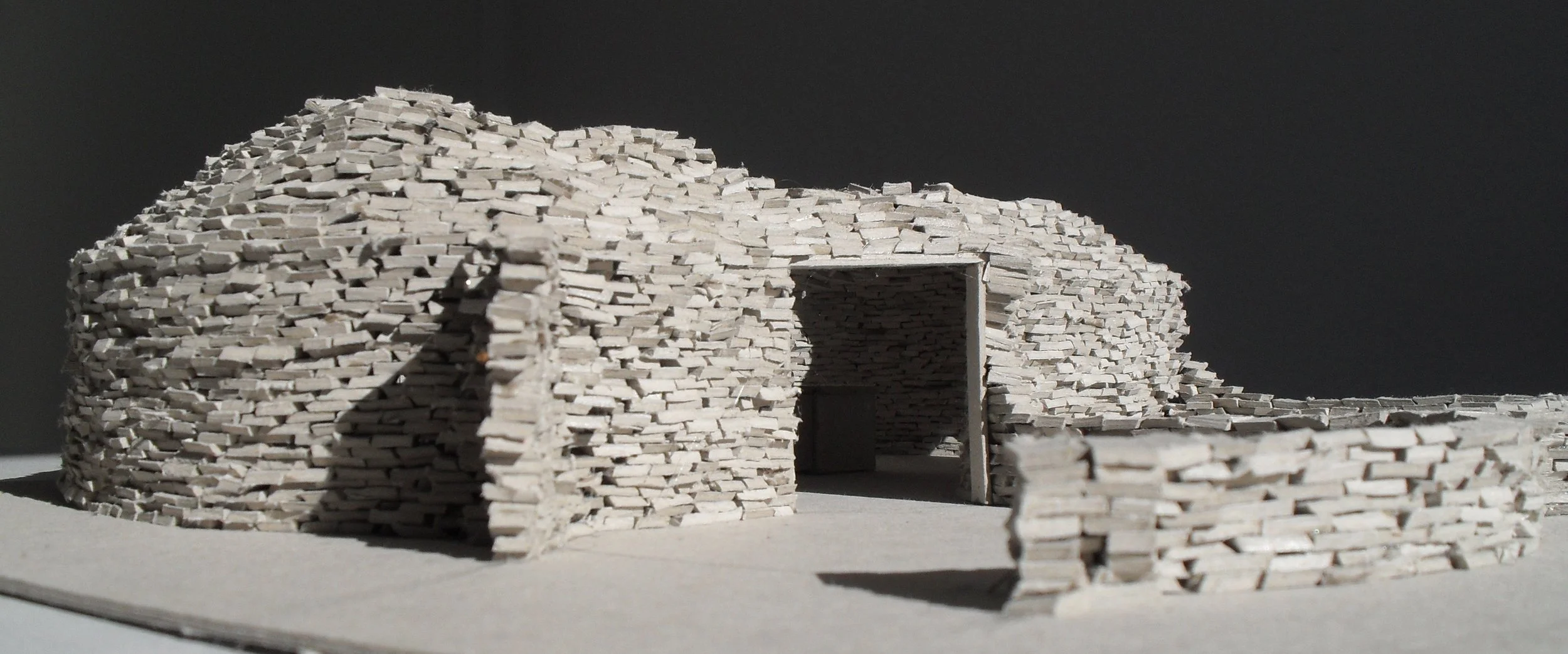
My initial approach to architecture as a discipline primarily concerned with creating spaces and places, has never really left me. I have used my archaeological studies directly however: a project to design an artists’ retreat on the Scottish coast immediately put me in mind of early-Christian monastic settlements, while the opportunity to design a multi-faith crematorium saw me return to prehistoric burial mounds and barrows. On a purely practical level, my excavation experience has given a great ability to investigate and assess historic buildings; identifying historic features and understanding the construction phase sequences of buildings. This experience has helped me secure at least two of my Architecture jobs and I like to joke that every time I find a historic feature on site, that’s £50 of my course fees written off! I’ve even had to do a bit of ‘site excavation’ on a couple of sites – once getting inside a chimney to investigate if the fireplace had originally been larger…
My love of history and historic buildings continues to impact my professional life. I am a member of the Society for the Protection of Ancient Buildings (SPAB) and a RIBA Conservation Registrant. On question I am often asked is why I never become a fully registered Conservation, or Specialist Conservation, Architect. Although I love history and working with historic buildings, I never want to these to be the only projects I work on. Making places and space for people means designing from scratch and I will never tire form designing new buildings. For me, it’s not the history that’s most important, it’s the people.