
How I Design
For someone who struggles with self-promotion, this feel likes a very self-indulgent journal entry, but I thought it was important to write about the process I go through when developing a design and how it might be a bit different from other Architects. Hopefully it will also provide a bit on an insight into the design process for those who may not be familiar with it.
It starts with a feeling
All architects and designers approach a project differently. Some will explore a range of data relating to the site and climate while others will take time to look at its history. For Architects like me, who deal predominantly with families and residential homes, we normally start with by having a long talk with our clients on site or over a drink. Many clients will come with a list of requirements and, often, rough sketches showing what they want but most want to explore what is feasible. It’s during these conversations and walking around the site that a sense of what the client wants to achieve starts to form and a picture or feeling for the project starts to emerge. For one client who needed a simple rear extension for their growing family, the image formed was of a summer barbeque with people being able to move freely between the garden and dining room table; this led to a floor plan focused on ease of movement with a focal point at the dining table. Whatever the image or feeling which develops from my conversation with the client, it tends to become leitmotiv which I return to throughout the rest of the project.
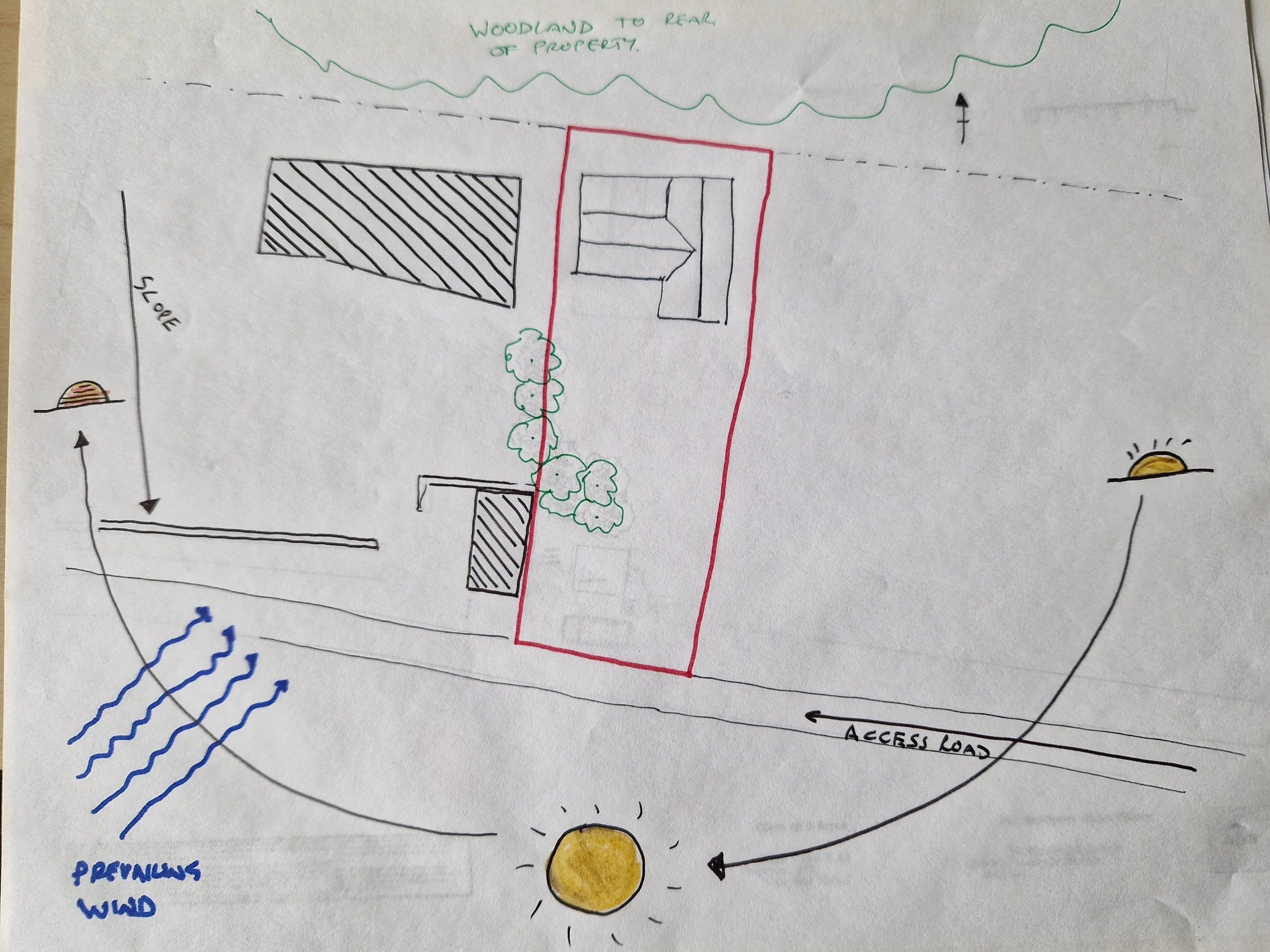
A simple site analysis plan.
Understanding the site
Following the brief from the client, the next important stage is to understand the site and its limitations. Sites with little or no limitations are seldom and, more often than not, developing a design within the confines of a site involves care and some compromise. Site analysis is one of the most fundamental aspects of the design process and it is pretty much the first thing students are taught at Architecture School. Knowing where the sun will be at different times of the day, where the prevailing wind comes from and a range of other factors helps to build up a picture of where any potential development is best suited. When dealing with historic or listed buildings as I often do, the site analysis also involves additional research into the site’s provenance and how it has developed over time. The site analysis is sometimes conducted at the same time as the development of the client brief as often the site will place limitations on what can be built. This can be a frustrating time for clients, juggling their desires with the realities of the space, but it’s often where that initial image or feeling becomes so vital as it helps to navigate a path through any compromises.
The places map
A thorough analysis of the site will produce a set of parameters which influence the design. As mentioned above, this often conflicts with the client’s brief and changes will sometimes need to be made but, for the most part, I will now be in the position to begin designing. My preferred method is to start with a printed copy of the site plan, a big roll of tracing paper, and some felt-tip pens. I mark out the information from the site analysis and then start to wite down and bubble areas where I think specific actions or activities (“places”) should occur. At this stage I’m not necessarily interested in putting down room labels or exact floor areas, it is more about understanding what atmospheres can be created and getting a feel for the scheme. An example of this process would be as follows: site analysis shows that a rear garden is only in direct sunlight from mid-afternoon onwards during the summer months suggesting that a focus on evening activities and entertaining would make the most of the space. On my paper I would write ‘evening sun – entertaining and dining’ and stick a bubble round it. At the end of this process I am left with a slightly chaotic-looking drawing covered in different coloured bubbles and text but, despite how it looks, this piece of tracing paper contains a huge amount of relevant information which can be refined into a coherent plan.
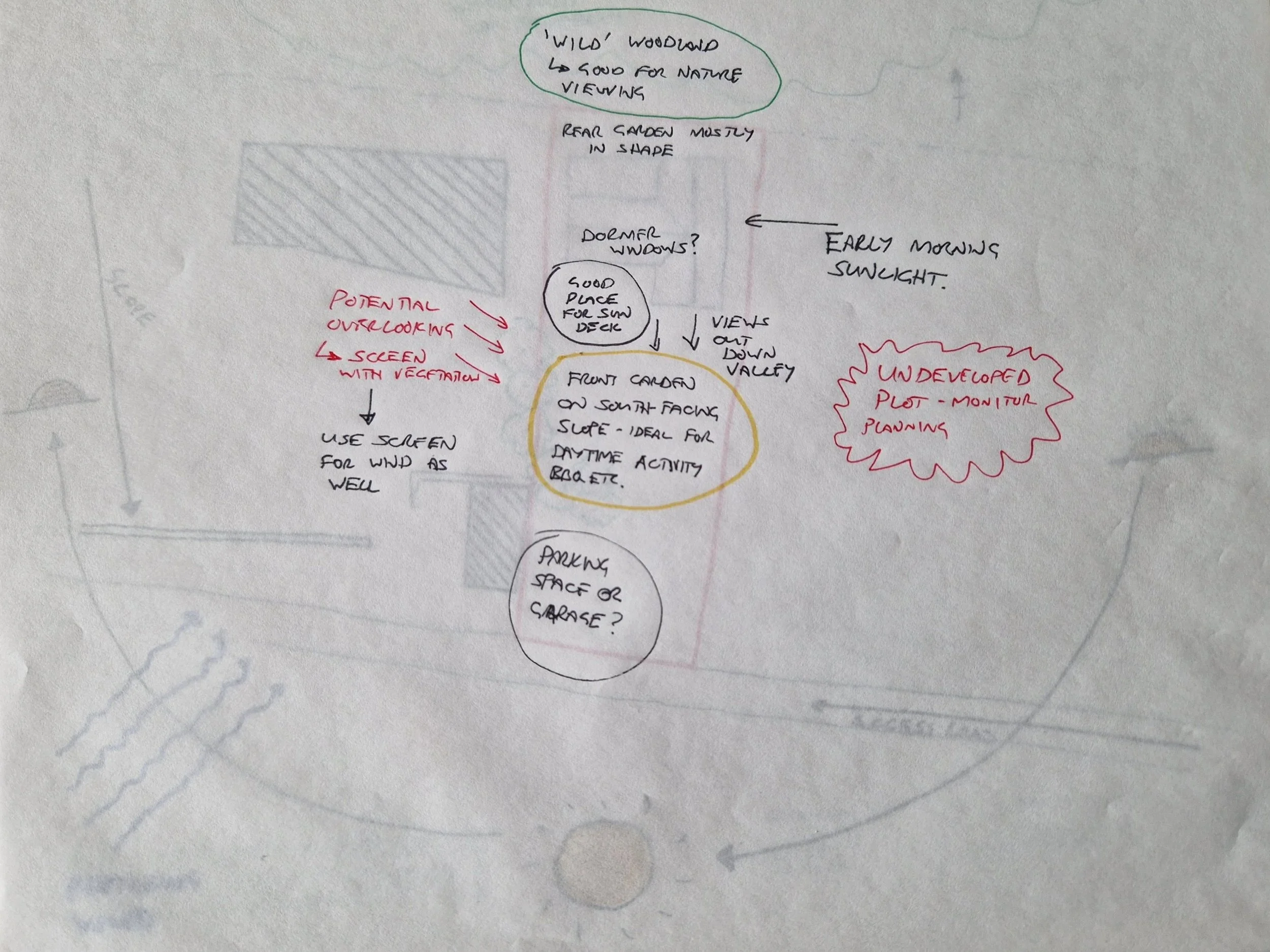
An example of a places map drawn over the site plan.
The sketch plan cycle
Once the places map has been finished, I take a clean piece of tracing paper and lay it over both the site plan and places map. I now start to synthesise my ideas and the client’s brief into a sketch plan with room layouts. Depending on the project, I will often do a series of very quick sketches to start with which look at different spatial configurations and layouts. Often, I will purposely draw unusual sketch plans which go against the places map just to check that I have not missed something important or that there is a better way of fulfilling the client’s brief. I believe that one of the roles and skills of an Architect is to give the client the design they haven’t thought of – Frank Lloyd Wright’s ‘Falling Water’ being a classic example of this. Once I have a rough idea (or ideas) of how I think the project is looking, I will then transfer the drawings onto the computer and make any further tweaks needed before producing a ‘finished’ set of sketch schemes. These will probably be the first set of drawings a client sees and I usually arrange a meeting to go through the plans in person with them; taking a spare set with me to draw and scribble notes over with the client. There will now be a cycle of amending and re-assessing the drawings until the client is happy with the proposal; we will also introduce elevation and section drawings at this stage and discuss how the project will look aesthetically. This cyclical process will take as long as it needs to develop a final scheme and reach what is often called ‘design freeze’. Reaching design freeze is a really important milestone in the project as it represents the end of the ‘big’ design process and the start of refining the detail. For most projects, this is the point where the scheme would be submitted for planning approval. Depending on the result of the planning process further changes might be needed but, in general, the project moves from spatial design to technical design.
I hope this has given you an idea behind my design process and how I work with clients to achieve their goals. Open House Architecture is always happy to meet and discuss any potential project with you free of charge as I firmly believe that the relationship between client and Architect is as important as the design. If you want to know more, then please get in contact via studio@openhousearchitecture.com or 07866766724.